Chemical Reactions Infographics: A Practical Resource for Visual Science Communication
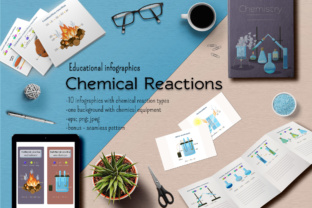
Visual learning has become a cornerstone of modern education, particularly in complex subjects like chemistry. The Chemical Reactions Infographics set offers a comprehensive and flexible toolkit for educators, content creators, and science communicators seeking to simplify chemical concepts through visual media. This collection includes 10 fully illustrated infographics covering key types of chemical reactions, along with supplementary assets such as chemistry-themed backgrounds and seamless patterns. With a variety of file formats—13 EPS, 17 JPG, and 40 PNG files—it's designed for seamless integration into multiple platforms and use cases.
What Makes This Infographic Set Stand Out?
The Chemical Reactions Infographics set distinguishes itself through its clarity, versatility, and attention to educational needs. Each infographic is fully illustrated and designed with a clean, professional aesthetic that supports comprehension without overwhelming the viewer. The inclusion of chemical reaction diagrams without text allows for customization, enabling users to add context or annotations tailored to their specific audience or curriculum.
One of the most valuable aspects of this set is its format diversity. EPS files provide scalability for print use, such as posters or textbooks, while JPG and PNG files are ideal for digital platforms like websites, presentations, and social media. This cross-format compatibility ensures that users can maintain visual consistency across different mediums without needing to recreate assets from scratch.
Designed for Educational Clarity
Each of the 10 infographics focuses on a distinct type of chemical reaction, including synthesis, decomposition, single displacement, double displacement, combustion, acid-base, redox, precipitation, isomerization, and polymerization. These are core concepts in general and organic chemistry, making the set relevant for high school, college, and even introductory university-level instruction.
The diagrams are intentionally designed without text, giving educators and creators the freedom to label and explain concepts in their own words. This flexibility is especially useful for multilingual audiences or for those adapting content to different learning levels. The visual structure of each diagram aligns with standard chemistry notation, ensuring accuracy while maintaining an accessible style.
Usability Across Platforms and Projects
One of the strongest attributes of the Chemical Reactions Infographics set is its adaptability. Teachers can use the visuals to enhance classroom presentations or handouts. Bloggers and science communicators can integrate them into articles or explainer videos. Publishers can incorporate the infographics into textbooks or online courses. Even app developers can utilize the PNG files for interactive educational tools.
For example, a science educator creating a unit on redox reactions could use the corresponding infographic in a Google Slides presentation, annotate it using screen-sharing software, and later repurpose the same image in a blog post or infographic handout for students. The availability of multiple file types ensures that these assets maintain quality across different resolutions and display formats.
Visual Quality and Design Consistency
The design of each infographic maintains a consistent color palette and visual language, which is crucial when presenting scientific information. The use of clear icons, labeled reaction arrows, and molecular representations aligns with common textbook visuals, reducing cognitive load for learners. Colors are distinct and well-contrasted, aiding visual differentiation between reactants, products, and reaction types.
The included chemistry background and seamless pattern offer additional creative flexibility. These can be used as page dividers in PDF guides, background elements in presentations, or decorative motifs in educational posters. Their seamless nature ensures they can be tiled or scaled without visible repetition or distortion.
Who Benefits Most from This Resource?
This set is particularly well-suited for educators who regularly create or update chemistry-related materials. It also serves content creators such as science bloggers, YouTubers, and educational app developers who need high-quality, ready-to-use visuals. Additionally, publishers and curriculum designers will find the set valuable for producing visually engaging textbooks, workbooks, or digital learning modules.
- Teachers and professors: Enhance classroom materials with accurate, visually engaging content.
- Science communicators: Use the infographics to break down complex ideas for general audiences.
- Course creators: Integrate visuals into online learning platforms or video lectures.
- Bloggers and writers: Illustrate science-based articles with professional-grade graphics.
Freelancers and small business owners who develop educational content can also benefit by using the infographics to streamline their design workflow and maintain a professional aesthetic across client projects.
Real-World Application and Limitations
In practical use, the Chemical Reactions Infographics set performs well across a range of educational contexts. For instance, a chemistry tutor building a series of explainer videos could use the PNG files directly in video editing software, overlaying voice narration and annotations. Similarly, a school textbook publisher could integrate the EPS files to ensure print-ready quality without having to commission original illustrations.
However, the set may not be sufficient for highly specialized or advanced chemistry topics. Users requiring detailed molecular structures or reaction mechanisms beyond the basic types may need to supplement with additional resources. Also, while the diagrams are accurate for general chemistry, they may not include advanced notation or IUPAC-standard formatting required for professional chemical publishing.
Long-Term Value and Workflow Integration
The Chemical Reactions Infographics set offers solid long-term value, especially for professionals who regularly produce educational or instructional materials. Once acquired, the assets can be reused across multiple projects, reducing the time and cost associated with creating visuals from scratch. The variety of file types ensures compatibility with most design and publishing tools, from Adobe Illustrator to Canva and PowerPoint.
For educators, integrating these visuals into a digital repository or shared drive can streamline lesson planning and content development. For freelancers, owning a versatile set like this can reduce reliance on stock image platforms or custom illustration services, ultimately improving project turnaround times and profitability.
Overall, the combination of visual clarity, format flexibility, and educational relevance makes the Chemical Reactions Infographics set a practical and professional resource for anyone involved in science education or communication. Whether you're developing a high school chemistry module or designing an online course, this collection offers a reliable visual foundation that supports both teaching and learning objectives.