Visualizing Equity: The Role of the Inclusive Classroom Teacher Set in Modern Education
The landscape of educational design has shifted dramatically over the last decade. No longer is it sufficient to simply present information; the medium through which that information is delivered must reflect the reality of the audience it serves. In an era where diversity, equity, and inclusion (DEI) are central to pedagogical strategies, visual assets play a critical role in shaping the narrative of learning. This is where resources like the Inclusive Classroom Teacher Set become essential tools for educators, designers, and content creators. These collections move beyond generic stock imagery to offer nuanced representations of collaborative learning environments that celebrate differences rather than merely acknowledging them.
The Evolution of Educational Illustration
Historically, classroom illustrations were often static and homogenous. They depicted idealized scenarios with uniform student populations and teachers who rarely reflected the demographic complexity of actual schools. While these images served a functional purpose in worksheets or presentations, they failed to resonate with students from underrepresented backgrounds. A child looking at a worksheet should see themselves represented in the margins, the characters, and the scenarios being discussed. When visual materials lack this representation, they can inadvertently signal exclusion, suggesting that the learning environment is not designed for everyone.
The transition toward inclusive design began as a reaction to this disconnect. Designers and publishers started seeking assets that featured students with disabilities, varying skin tones, different cultural attire, and diverse family structures. The Inclusive Classroom Teacher Set represents the culmination of this trend, offering a curated collection that prioritizes authenticity. By utilizing clean colored line art and vibrant palettes, these illustrations avoid the pitfalls of caricature while maintaining a modern, engaging aesthetic suitable for digital and print media alike.
Bridging the Gap Between Theory and Visual Practice
For many educators, the theory of inclusive education is well-established, but the practical application in daily materials remains a challenge. Finding high-quality visuals that align with DEI principles without compromising artistic quality is often difficult. Free resources frequently lack the resolution required for professional printing, while premium stock photos can be prohibitively expensive or too specific to a single context. Vector-based solutions offer a middle ground, providing scalability and editability that allow users to adapt the imagery to their specific needs.
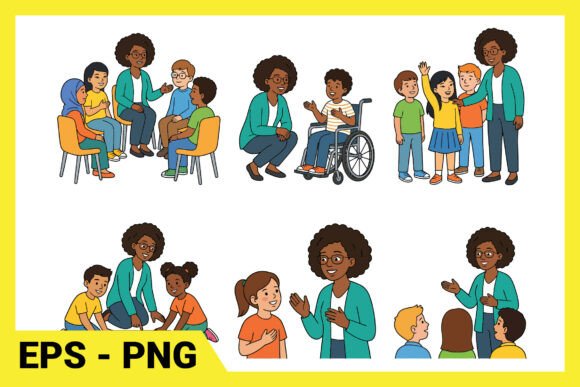
When a teacher selects an asset from an Inclusive Classroom Teacher Set, they are choosing more than just a picture; they are selecting a tool for communication. These illustrations serve as conversation starters about diversity and ability. For instance, an image showing a teacher leading a discussion with a student using a wheelchair or a student communicating via sign language normalizes these experiences within the academic setting. It signals to all students that the classroom is a space where every ability and background is valued and integrated into the learning process.
Technical Advantages of Vector-Based Learning Resources
From a technical standpoint, the format of these illustrations is just as important as their subject matter. The availability of fully editable EPS vector files alongside transparent PNGs provides unparalleled flexibility for creative professionals. Unlike raster images, which lose quality when resized, vector graphics maintain crisp edges and clarity regardless of scale. This is crucial for educational materials that may need to appear on a small mobile screen for an online lesson plan or be blown up to poster size for a school hallway display.
The ability to customize colors is another significant advantage. Schools and districts often have specific branding guidelines, including official color palettes. With editable vector files, a designer can easily adjust the hues of the clothing, the classroom furniture, or the background elements to match institutional standards without needing to redraw the entire scene. This adaptability extends to accessibility considerations as well. Designers can modify contrast ratios or simplify line weights to ensure that the illustrations remain legible for students with visual impairments.
Streamlining the Content Creation Workflow
Efficiency is a major concern for busy educators and instructional designers. Creating custom illustrations from scratch requires significant time and specialized software skills, which many teachers do not possess. Pre-made sets streamline the workflow by providing ready-to-use assets that still feel bespoke due to their editability. A curriculum developer can take a base image of a group discussion and quickly swap out elements to fit a specific lesson topic, whether it is a science experiment, a literature circle, or a math problem-solving session.
This efficiency does not come at the cost of quality. The clean line art style found in these sets ensures that the illustrations remain timeless. Trends in graphic design change rapidly, but simple, bold lines and vibrant colors tend to age well, ensuring that materials created today will not look outdated in five years. Furthermore, the transparency of PNG files allows these images to be layered over various backgrounds, making them versatile for use in slide decks, website headers, and social media graphics promoting school events.
Real-World Applications Across Sectors
The utility of an Inclusive Classroom Teacher Set extends far beyond the traditional K-12 classroom. As the definition of "education" broadens to include corporate training, online learning platforms, and community workshops, the demand for inclusive visual language increases across all sectors. Understanding where and how to apply these assets maximizes their impact and ensures consistent messaging throughout an organization.
- School Projects and Worksheets: Teachers can integrate these images directly into printable worksheets, creating a sense of familiarity and comfort for students. Seeing diverse characters engaged in learning tasks helps reduce anxiety and fosters a positive attitude toward schoolwork.
- Digital Presentations and LMS: Online learning platforms rely heavily on visuals to break up text and maintain engagement. Using inclusive illustrations in Learning Management Systems (LMS) ensures that remote learners feel connected to the material and the broader educational community.
- Classroom Decorations: Physical spaces influence behavior and mindset. Posters and bulletin boards featuring diverse groups of students working together reinforce the values of collaboration and respect every day.
- Print-on-Demand Products: Entrepreneurs and small business owners can utilize these designs to create merchandise such as t-shirts, mugs, and tote bags. These products can support fundraising efforts for schools or serve as gifts for graduating classes, spreading the message of inclusivity to a wider audience.
- Educational Publishing: Publishers developing textbooks or supplementary reading materials require high-resolution, legally clear images. Vector files provide the necessary quality for print production while ensuring that the content reflects modern societal values.
Fostering Empathy Through Representation
The psychological impact of representation cannot be overstated. When students see themselves reflected in the materials they use, it validates their existence and experiences. Conversely, when students see peers with different abilities or backgrounds portrayed positively and actively participating in class, it builds empathy and reduces prejudice. The Inclusive Classroom Teacher Set facilitates this by depicting interactions that are natural and respectful.
Consider the dynamic of a classroom discussion. An illustration showing a teacher facilitating a dialogue among students of various ethnicities and abilities demonstrates that knowledge comes from many sources. It challenges the stereotype of the passive student and the authoritative teacher, replacing it with a model of collaborative inquiry. This visual narrative supports the pedagogical shift toward student-centered learning, where the teacher acts as a guide rather than the sole source of information.
Supporting Special Needs Education
One of the most critical aspects of these sets is the accurate and dignified portrayal of students with disabilities. Too often, disability is either ignored or sensationalized in educational media. High-quality inclusive illustrations show students with assistive technologies, mobility aids, or sensory tools as integral parts of the classroom ecosystem. They are shown learning, playing, and collaborating just like their peers. This normalization is vital for special needs education, helping to dismantle barriers and foster an environment where accommodations are viewed as standard practice rather than exceptions.
Strategic Considerations for Implementation
While the benefits of using inclusive visual assets are clear, successful implementation requires thoughtful consideration. Simply inserting a diverse image into a document is not enough; the context matters. Educators and designers must ensure that the usage of these illustrations aligns with the broader mission of their institution or project. Authenticity is key; the goal is to represent diversity naturally, avoiding tokenism where individuals are included solely to check a box.
Furthermore, licensing and commercial rights must be carefully reviewed. Since these sets are often used for both personal and commercial projects, understanding the scope of the license is crucial for businesses and publishers. The availability of editable files allows for customization, but users must adhere to the terms regarding redistribution and modification. Ensuring compliance protects the integrity of the work and supports the artists and creators behind these valuable resources.
Future Trends in Educational Design
Looking ahead, the demand for inclusive and customizable educational assets will only grow. As technology advances, we may see the integration of these vector illustrations into interactive digital environments, augmented reality experiences, and adaptive learning software. The core principle, however, will remain the same: education is a shared human experience that thrives on diversity. Resources like the Inclusive Classroom Teacher Set provide the foundational visual language needed to build a future where every learner feels seen, heard, and valued.
By embracing these tools, educators and designers contribute to a culture of belonging. They create spaces—both physical and digital—where collaboration is encouraged, differences are celebrated, and the potential of every student is recognized. In a world that is increasingly interconnected, the ability to visualize and teach inclusivity is not just an aesthetic choice; it is a necessity for preparing the next generation to thrive in a global society.