Mastering the Four-Piece Jigsaw Puzzle for Early Learning
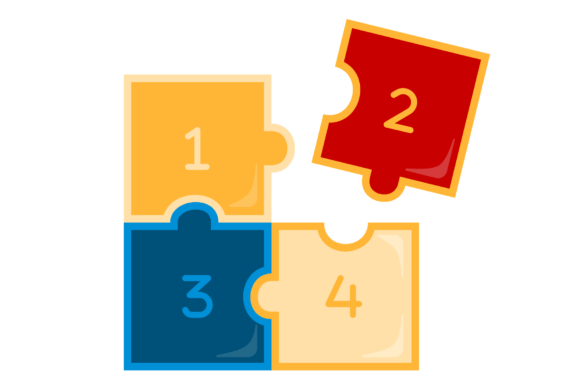
When you introduce a Four-Piece Jigsaw Puzzle into an educational setting, you are not simply handing out a toy; you are deploying a foundational tool for cognitive development. This specific format, characterized by its interlocking pieces in distinct colors like yellow, red, blue, and cream, serves as a critical bridge between abstract thinking and concrete logic. For educators, app developers, and parents, understanding how to leverage this simple graphic correctly can make the difference between a child grasping a concept instantly or becoming frustrated and disengaged.
The Logic Behind the Simplicity
The appeal of the Four-Piece Jigsaw Puzzle lies in its deliberate constraints. Unlike complex puzzles with dozens of pieces that test patience, this four-piece set tests immediate pattern recognition and sequencing. The inclusion of numbers one through four on each piece transforms a visual task into a logical sequence exercise. When a child matches the yellow piece labeled "1" with the red piece labeled "2," they are practicing ordinality and color association simultaneously.
This structured approach is why the illustration is so effective for daycare signage, elementary worksheets, and learning apps. It provides a clear, organized feel that reduces cognitive load. However, the simplicity often leads to a dangerous assumption: that any four-piece image will work just as well. This is where many professionals stumble, overlooking the nuances that make this specific design effective.
Common Pitfalls in Selection and Application
One of the most frequent mistakes I see creators and educators make is ignoring the clarity of the interlocking mechanism. In a rush to create custom content, designers often produce puzzle pieces that look visually similar but lack distinct tabs and blanks. If the yellow piece does not physically or visually lock into the blue piece with obvious precision, the child loses the sense of accomplishment. The frustration isn't about the difficulty; it's about the ambiguity of the fit.
Another significant oversight involves the color palette. While the standard set uses high-contrast colors like red, blue, yellow, and cream, some variations dilute these into pastels or muddy tones. For early childhood education, contrast is king. A pale yellow piece against a cream background creates visual noise rather than clarity. This mistake directly impacts usability and efficiency. If a child cannot distinguish the boundary between pieces, the logic lesson fails before it begins.
We also frequently see the numbering system applied inconsistently. Sometimes the number is too small, sometimes it is placed in a corner that gets cut off during printing, and other times the font style changes from piece to piece. These inconsistencies disrupt the flow of learning. The goal is to reinforce the sequence 1-2-3-4 as a predictable pattern. Breaking that visual rhythm confuses the learner and undermines the educational value of the Four-Piece Jigsaw Puzzle.
The Impact of Poor Design on Learning Outcomes
When these details are overlooked, the consequences extend beyond a single failed activity. In a classroom or app environment, a confusing puzzle can lead to a loss of confidence. A child who struggles to match pieces due to poor color contrast may conclude they are "bad at puzzles" rather than recognizing the material is flawed. This affects their willingness to engage with future logic tasks.
For entrepreneurs and marketers creating digital assets, using low-quality or poorly designed puzzle graphics can damage brand perception. Parents and teachers looking for resources expect professional, polished tools. If your worksheet features a blurry, misaligned puzzle, it signals a lack of attention to detail elsewhere in your product line. It suggests that the creator did not understand the developmental needs of the target audience.
Furthermore, inefficiency in the design process often leads to wasted time. Teachers spending minutes explaining why a piece doesn't fit when it should have been obvious detracts from actual instruction time. The beauty of the numbered, color-coded system is that it should be self-explanatory. When it isn't, the teacher becomes a troubleshooter instead of a facilitator.
Strategies for Better Implementation
To avoid these pitfalls, you must prioritize clarity above creativity. When selecting or designing a Four-Piece Jigsaw Puzzle, ensure the edges are bold and distinct. The interlocking shapes should be exaggerated slightly for younger audiences so the connection point is unmistakable. Think of it as architectural engineering for toddlers; every joint must be secure and visible.
Stick to the proven color scheme unless you have a specific pedagogical reason to change it. The combination of primary colors (red, blue, yellow) with a neutral base (cream) offers the best balance of excitement and readability. If you are adapting this for a specific theme, such as nature or space, maintain the high contrast. A dark blue sky piece should clearly separate from a lighter cloud piece, just as the red and yellow pieces do in the classic model.
Pay meticulous attention to the numbering. The numbers should be large, centrally located, and use a sans-serif font that is easy to read. Ensure the sequence is logical and consistent across all your materials. If you are creating a series of puzzles, keep the numbering style identical so children build a mental schema of what "numbered order" looks like.
What to Check Before You Decide
Before downloading, buying, or creating your own version of this educational graphic, run a quick quality check. First, zoom in on the image. Are the lines crisp? Do the tabs and blanks align perfectly? Second, print a test copy if possible. Colors on a screen often differ from paper, and a subtle shift can ruin the contrast needed for young eyes.
Third, evaluate the context. Is this puzzle intended for a tactile experience or a digital drag-and-drop interaction? If it is for an app, ensure the touch targets are large enough for small fingers. If it is for a worksheet, ensure the paper weight is sufficient to handle repeated cutting and assembling without tearing.
Finally, consider the progression. A Four-Piece Jigsaw Puzzle is a starting point, not an endpoint. Plan how you will transition learners from this simple four-piece format to more complex challenges. The skills learned here—sequencing, color matching, and spatial reasoning—are the building blocks for advanced problem-solving. By choosing high-quality, logically sound materials now, you lay a solid foundation for those future successes.
In summary, the power of this educational tool lies in its execution. By avoiding common design errors and focusing on clarity, contrast, and consistency, you ensure that every child has the opportunity to experience the satisfaction of solving a problem correctly. Whether you are a blogger writing about cognitive development or a business owner selling learning kits, treating the Four-Piece Jigsaw Puzzle with the respect it deserves will yield better results for everyone involved.